Let’s make a Theory of Change in 5 Steps
You’re convinced a Theory of Change will be helpful.
You generally understand the component parts.
You may have even downloaded a template or sat through a workshop.
And now you’re staring at the computer screen…it feels a little tricky. Obtuse, even.
Where do you actually start?
How do you know if you’re “doing it right”?
Why does something that seems straightforward suddenly feel so complicated?
At Raya Cooper Impact Consulting, we have made more than our fair share of Theories of Change. We’ve found that creating a good one isn’t about finding the perfect framework. It’s about having the right conversations.
A Theory of Change is ultimately a shared understanding of how and why change happens — and your organization’s role within it. This matters just as much as the final diagram.
Here’s how we approach it. If you’ve worked with us, this will sound familiar. And if you haven’t, this hopefully will help you get started.
SET YOURSELF UP FOR SUCCESS“Success with a creating a Theory of Change depends on having the right people in the room and protecting the time and space”
Before you jump into spreadsheets, pause and think about who needs to be part of the process. Strong Theories of Change are collaborative. They require reflection, discussion, and sometimes a little healthy disagreement.
Two things matter early on:
Have the right people in the room
This means representation across roles and teams — leadership, program staff, business partners and others who understand different parts of the work.
It also means including, whenever possible, the perspectives of the people your work is intended to support. Direct beneficiary voices are essential. When direct participation isn’t possible, thoughtful proxies can still help ground the conversation in actual lived experience, not just your assumptions.
Protect the time and space
This work takes time. Not endless time — but enough time for people to think, reflect, and refine ideas together.
Create some protected time - this could be through a full day retreat, a series of working sessions, or even a series of small dedicated conversations. At RCIC, we help clients figure out the cadence and approach that will work best for them.
Now that you have the right people and the time to think, you’re ready to get started. Set up yourself and the team up to move through the following conversations.
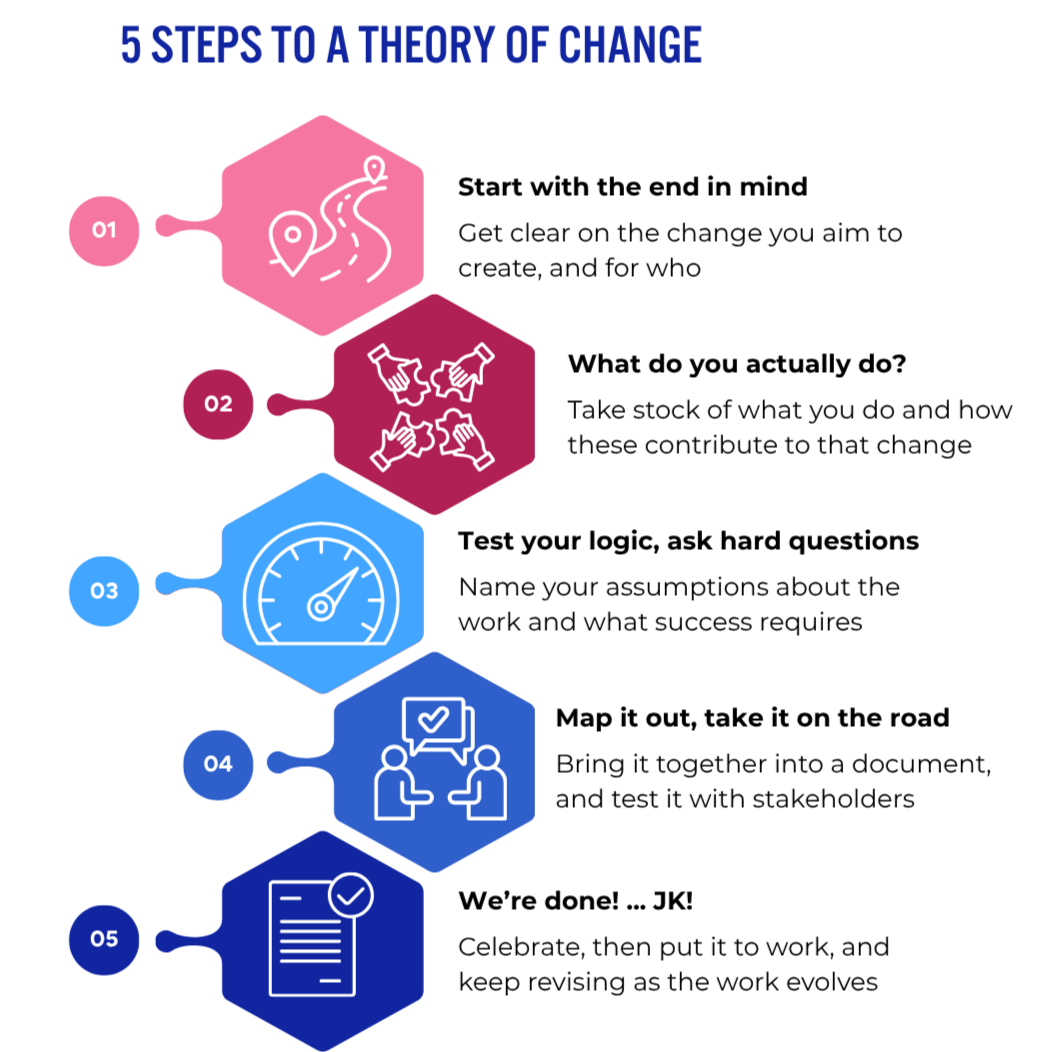
Step 1 : start with the end in mindThis is where we usually start at Raya Cooper - at the end. Before talking about programs or activities, get clear on the change itself.
Who is this change for?
What change do we want to see for them?
At this stage, you’re not trying to wordsmith perfect outcome statements. Over time, these ideas can be refined and prioritized into formal outcomes.
Step 2 : what do you actually do?This sounds simple, but it’s often where organizations uncover important strategic insights.
If you already have a mission and goals, the next question is:
What activities are we actually doing to advance them? List them out and be specific.
Why do we do each activity? What change is it intended to influence?
Sometimes you’ll find there are some activities that don’t clearly connect to a goal. Other times, you may realize you have ambitious goals with very few activities to get you there.
A Theory of Change process can surface where strategy has drifted, how work has expanded over time, or what priorities may need revisiting.
Pro Tip: At this stage, its common to have a very strong feeling that the strategy you have is still not right or finalized. Often, this is where we see the panic set in, and folks start to ask if we need to pause in order to hammer out the strategy. We urge you to keep going - you’re in the messy middle. What you create will not be perfect — not today and not tomorrow, so just keep going.
Step 3 : Test your logic, ask the hard questionsAt its core, a Theory of Change is an ‘If, Then” statement - “If we do this, then that will happen”. It reflects both a theory and our assumptions about our goals and what we believe will get us there. This stage is about pressure-testing this logic an those assumptions.
What needs to be true for your activities to generate the outcomes you’re aiming for? For example:
Do participants need to consistently engage?
Are there external barriers that could interrupt progress?
Are there assumptions about access, trust, or capacity built into the model?
One of the most common challenges in Theory of Change development is jumping too quickly from activities to big aspirational outcomes. As we know, change usually happens through a series of smaller shifts, such as:.
Increased awareness
Improved skills or confidence
Changes in behavior or decision-making
Stronger relationships
These conversations are often some of the most valuable parts of the process because they make implicit thinking visible.
This stage will generate your short- and mid-term outcomes.
Step 4 : map it out and take it on the roadOnce the core pieces are clearer, it’s time to put structure around them.
A Theory of Change can use a standard template, or you can create a visualization that shows how all the pieces fit together and ladder up.
A Theory of Change will show
Inputs
Activities
Outputs
Outcomes - sometimes they are broken out into time horizons (short-, mid-, and long-term), depending on the work.
Context and assumptions
We often do this work over multiple iterations, as we review and refine with stakeholders. Be sure to share it with the people and communities most closely connected to the work. Ask yourselves and others:
Does this resonate?
Does this reflect how change actually happens?
What feels missing?
What feels unrealistic?
Are the outcomes meaningful?
Are the assumptions accurate?
Step 5: We’re done … HAHa! JK!Many organizations feel a sense of relief once the diagram is complete. But the Theory of Change is not meant to sit untouched in a slide deck or strategic plan document.
The real value comes from using it to guide strategy, inform measurement, support communication, align teams and strengthen our decision-making over time. This document will be a living document that will be revisited and changed over time. You can even use it together with a Materiality Assessment. Make a plan for when you will revisit it - typically this is every 2-3 years, but can be more frequent if needed.
Don’t let perfect be the enemy of the good
A Theory of Change does not need to be perfect to be useful. One of the biggest pitfalls we see is the seemingly endless round of wordsmithing and editorial revisions that can befall a Theory of Change.
Because you will continue to iterate and grow this document over the years, decide when it is “good enough” to move forward and start using it. As long as it is honest, thoughtful and clear, you can start to use it to make decisions, communicate impact, and learn over time.
We’re here to help
Building a Theory of Change can feel overwhelming, especially when you're staring at a blank page and trying to connect ambitious goals to meaningful outcomes. The good news? You’re not alone.
At Raya Cooper Impact Consulting, we help organizations move through collaborative, facilitated Theory of Change processes. We help you bring together the right stakeholders, then guide the critical conversations to build a shared understanding of how change happens—so you can create a Theory of Change that is not only thoughtful and actionable, but one your team will actually use.
Whether you're developing a Theory of Change for the first time, revisiting an existing one, or looking to strengthen the connection between strategy, measurement, and impact, we'd love to help. Let's talk about where you are in the process and how we can support your next steps.